


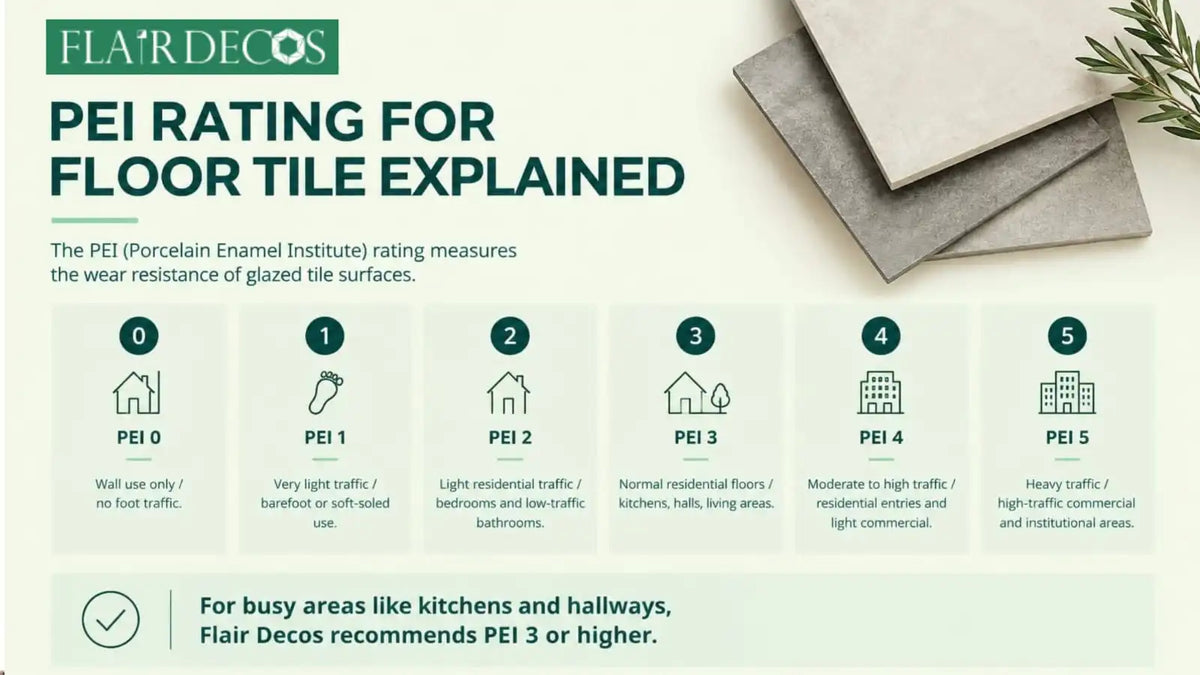
The PEI rating for tile tells you how well a glazed tile's surface resists wear from foot traffic, on a scale from 0 to 5. It is one of the most useful specs to check before choosing floor tile, but only if you know what it does and doesn't cover.
This PEI rating guide answers what PEI rating is, walks through the PEI rating chart, how the rating is tested, and gives the PEI rating for floor tile room by room.
What Is PEI Rating?
PEI stands for Porcelain Enamel Institute. A PEI rating is a 0 to 5 class that describes how well a glazed tile's surface resists wear. On floor tile, it answers one question: how well will the glaze hold up to foot traffic?
PEI Rating Chart: The 0 to 5 Scale
A higher class means a surface rated for more foot traffic. These are the commonly published classes:
|
PEI class |
Commonly published description |
|---|---|
|
0 |
No foot traffic |
|
1 |
Very light |
|
2 |
Light |
|
3 |
Light to moderate |
|
4 |
Moderate to heavy |
|
5 |
Heavy to extra heavy |
Wording can vary slightly by source, so use this tile wear rating chart as a guide. The manufacturer's data sheet is the reference for each tile. Classes 1 and 2 describe light foot traffic tile.
How Is PEI Rating Tested?
PEI classes are commonly assigned from tile abrasion resistance test results. The glaze is worn with a rotating abrasive load, and the result is judged by visual comparison with an unworn tile.
Two standards cover this kind of testing:
- ASTM C1027, "Standard Test Method for Determining Visible Abrasion Resistance of Glazed Ceramic Tile".
- ISO 10545-7, "Ceramic tiles, Part 7: Determination of resistance to surface abrasion for glazed tiles".

What PEI Measures (and What It Doesn't)
PEI measures the wear resistance of the glazed surface, and nothing else. It does not measure:
-
Slip resistance
-
Breaking strength
-
Water absorption
-
Stain resistance
Glazed tile durability against wear is only one part of how a tile performs, so check the other specifications too.
Does Unglazed Tile Have a PEI Rating?
No. PEI applies to glazed tiles only, so unglazed or through-body tiles have no PEI rating. In glazed vs unglazed tile PEI comparisons, only the glazed tile carries a number.
Is Porcelain or Ceramic Tile More Durable?
PEI alone can’t tell you. PEI rates how well the glaze resists wear from foot traffic, not what the tile is made of, and both porcelain tile and ceramic tile can be glazed. A glazed porcelain tile and a glazed ceramic tile can carry the same PEI class.
To compare durability between the two, check the other specs on the manufacturer’s data sheet, such as breaking strength, water absorption, and slip resistance, since PEI doesn’t cover any of them.
Best PEI Rating for Floor Tile, Room by Room
PEI Rating for Living Room Floor
Choose PEI 3 or higher. Living rooms see steady daily traffic and often connect to hallways and kitchens.
PEI Rating for Kitchen Floor
For kitchen floors, choose PEI 3 or higher. Kitchens are busy, and this matches Flair Decos guidance. For the wall behind the counter, look at backsplash tile. Note that wall tiles should not be used on floors, while floor tiles can generally be used on walls.
PEI Rating for Bathroom Floor
Bathrooms usually see lighter foot traffic than kitchens, so PEI 2 or 3 is commonly considered for wear. PEI says nothing about slip resistance or water absorption, which matter in a wet room. Waterproofing depends on proper installation by a qualified installer following the manufacturer's instructions and applicable standards, not on PEI.
PEI Rating for Bedroom Floor
Bedrooms are a good fit for light foot traffic tile. PEI 2 is commonly considered enough for wear, and PEI 3 adds margin.
PEI Rating for Hallway
Choose PEI 3 or higher. Hallways funnel everyone's foot traffic through one narrow path.
PEI Rating for Entryway
Entryways and mudrooms are where heavy traffic floor tile thinking applies. Consider PEI 4, since shoes carry in grit and every trip through the door crosses the same spot.

PEI Rating for Balcony Tile
Outdoor suitability depends on more than PEI, for example water absorption and freeze-thaw suitability. Check the full specifications, and start with the outdoor collection.
PEI 3 vs PEI 4: Quick Answers
Is PEI 3 Tile Good for Floors?
Yes. PEI 3 is rated light to moderate foot traffic, which fits many residential floors including the kitchen and hallway tiles covered by Flair Decos's PEI 3 or higher guidance. For entryways and mudrooms, consider PEI 4.
PEI 3 vs PEI 4 Tile: What Is the Difference?
The difference is the wear class: PEI 3 is light to moderate, and PEI 4 is moderate to heavy. PEI 4 suits busier spots, while PEI 3 can be plenty for typical residential rooms. A higher number doesn't make a tile better overall, because PEI doesn't cover slip resistance, strength, water absorption, or stain resistance.
PEI Rating for Commercial and High-Traffic Floors
For commercial floor tile rating, look at PEI 4 and PEI 5. PEI 4 is moderate to heavy, and PEI 5 is heavy to extra heavy. When weighing PEI 4 vs PEI 5 commercial tile, match the class to the expected traffic.
Commercial spaces, entryways, and mudrooms are where heavy traffic floor tile belongs. For a restaurant floor tile rating, remember that PEI doesn't address slip resistance. Residential vs commercial tile rating decisions come down to how much traffic the space sees.
Contractors comparing tile specifications for high traffic floor tile should rely on the manufacturer's data sheet and the project's requirements.
Shop Floor Tile and Plan Your Project With Flair Decos
Browse floor tile at Flair Decos, including porcelain floor tile and ceramic floor tile. Before you choose tile for a busy space, check the PEI class on the manufacturer’s spec sheet and match it to how much traffic the room will see.
When you’re ready to plan, our square footage calculator can help you estimate how much tile you need, and we strongly encourage ordering a sample so you can see the color and finish in person.
Have questions about a tile’s specs or your delivery? Reach out to our team, or browse our FAQ page and more guides on the Flair Decos blog.