


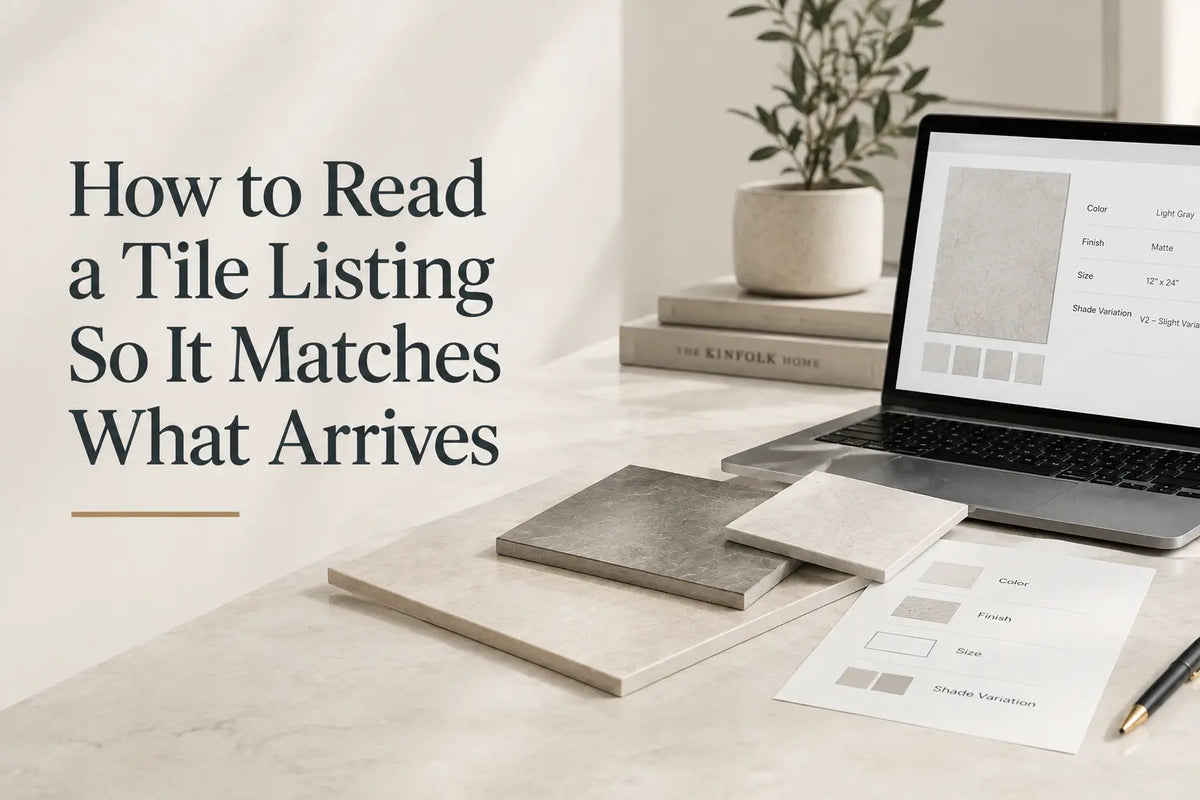
A tile listing tells you everything you need to know before you order — if you know which fields actually predict what arrives. The photo is the least reliable part of the page; the specification fields are where the real information lives.

What a Tile Listing Actually Tells You (and What It Doesn't)
A well-built listing separates what's fixed (size, composition, performance ratings) from what naturally varies (color tone, veining, texture). Learning to read a tile listing means knowing which of those two categories each field falls into.
Photos show you one tile, from one lighting setup, on one screen. Specs describe the entire product line — browse our full tile collection to see how listings are structured across brands like Daltile, Marazzi, MS International, American Olean, Bedrosians, and Ottimo.
The Specs That Determine What Arrives
Composition, Design & Surface Type
Composition is the base material — porcelain, ceramic, or natural stone — and it drives durability and where the tile can go. Design describes the visual pattern (wood-look, marble-look, solid).
Surface type tells you the finish: matte, glossy, or honed. A honed tile finish has a smooth, low-sheen surface that reads differently in person than in a bright product photo, so this field matters more than the image does.
Sizes, Ends & Edges
Sizes are listed to a fraction of an inch, and that fraction changes your grout lines. Common formats range from small mosaics to classic subway tile dimensions (usually 3x6 or 4x8) up to oversized planks.
Ends and edges describe how the tile is finished at its border — rectified (precisely cut, tighter grout lines) or non-rectified (slightly rounded, wider grout lines). Edge type also determines which trim pieces, like Schluter profiles, will actually fit.
Performance Specs: Water Absorption, Slip Resistance, Durability & Strength
Water absorption rating tells you if a tile is rated for wet areas like showers. Slip resistance (often shown as a DCOF number) tells you if it's safe for wet floors or high-traffic entries.
Durability and wear ratings (PEI rating) show how much foot traffic a tile can take, and strength/resistance specs cover impact and staining. These fields predict how the tile performs — the photo can't tell you any of this.
Shade Variation, Installation Type & Application
Shade variation (often shown as a V-rating) tells you how much color and pattern difference to expect tile to tile, even within the same box. Dye lot is a related but separate field — it flags variation between manufacturing batches of the same product.
Installation type (thin-set, click-lock, adhesive) and application (floor, wall, backsplash, exterior) confirm the tile is rated for where you're putting it — a wall-only tile won't hold up as flooring, no matter how the photo looks. See application-specific listings in our backsplash tile collection.
Why Photos Alone Can Mislead You
Listing photos are shot under controlled lighting on a single tile, and monitors render color differently from one device to the next. That gap is exactly why the spec fields, not the image, should drive your decision.
The safest check before ordering is comparing the listed shade-variation rating to the photo — if the rating is high, expect more real-world variation than the single photo suggests. Reach out to our team to request a physical sample before committing to a full order.
Reading Specs at Scale for Commercial Projects
Contractors and property managers ordering tile across many rooms can't rely on a single photo matching every batch — spec fields are what keep a multi-unit project consistent.
When Home2 Suites sourced tile for its guest bathrooms, matching the specification sheet — not just the listing photo — is what kept every room consistent across the property. For bulk or trade orders, contact our team directly for support.

Nationwide Shipping, Local Support
Flair Decos ships tile, flooring, and furniture nationwide via LTL freight from our base in St. Petersburg, Florida. Reading the listing correctly before you order is what makes sure the freight that arrives matches what you compared — see our shipping policy for delivery and inspection details.
Common Questions About Tile Listings
What does "rectified" mean on a tile listing?
Rectified means the tile's edges are precisely cut to an exact size, allowing for tighter, more uniform grout lines than a non-rectified tile.
Why do tile listings mention shade variation?
Shade variation ratings tell you upfront how much color and pattern difference is normal within the same product line, so it's expected rather than a surprise after installation.
Should I order a sample before buying tile online?
Yes — a physical sample is the only way to see true color, texture, and finish under your own lighting before committing to a full order.
Once you've matched the right spec, the last step is knowing how much to order. Use our square footage calculator to figure out exactly how much tile you need before checkout, so an accurate spec match doesn't get undercut by an inaccurate order quantity.